
TDCJ Releases for Cass Cases
The Texas Department of Criminal Justice is a statewide prison and state-jail system, not the Cass County Jail. Its official unit directory does not list a TDCJ unit in Cass County. A Cass County defendant sentenced to TDCJ may be placed wherever the agency assigns the person. Nearby geography is not a sound search key. Use the statewide offender record, then verify the county of conviction, identifiers, offense, and sentence.
A TDCJ release can lead to parole, mandatory supervision, or flat discharge. Parole is conditional community release before sentence expiration. Mandatory supervision is a distinct statutory supervised-release path. Discharge means the sentence has ended. A release may also be blocked or converted into a transfer by a detainer or hold. Each label carries a different legal meaning and should remain attached to the TDCJ record.
Confirm a TDCJ Release
The first route is the TDCJ Online Inmate Search. It commonly accepts last name, first name, TDCJ number, SID number, gender, and race. A detail record may show projected release date, maximum sentence date, current facility, county of conviction, offense, sentence date, sentence length, and parole-review information. Preserve the exact field label instead of calling every date a release date.
- Search by TDCJ or SID number when available. Otherwise use the name and offered demographic fields.
- Match the identifier and county of conviction. Do not rely on a same name or photo alone.
- Read projected release, maximum sentence, parole-review, and scheduled-release fields separately.
- If the live result is absent or incomplete, use TDCJ's email or telephone inmate-information route.
- For actual release history, request the state incarceration and release or discharge record rather than inferring from a missing result.
The Cass County released inmate search paths explain how the earlier county booking and later state record fit together. A sheriff record proves the handoff from county custody. TDCJ proves the state phase.
Note: TDCJ does not promise that every fully discharged former inmate remains visible in the ordinary live offender search.
TDCJ Records for Cass Convictions
TDCJ offers inmate information online, by email, and through its telephone lookup channel. For the enumerated email fields, send the full name and seven-digit TDCJ number to pia@tdcj.texas.gov. If the number is unknown, provide the exact date of birth or approximate age and the county of conviction. Put the inmate's name in the subject line and identify the fields requested. TDCJ describes this routine information as available without charge.
Email: pia@tdcj.texas.gov
Official inmate-information channels
Ask for prior incarceration, actual release or discharge history, and the labeled projected date when relevant.
The email channel expressly offers TDCJ number, location, offense of conviction, prior incarceration history, current incarceration, and projected release date. It does not provide photographs or Social Security numbers. Broader institutional records use the Public Information Act process and may be redacted for privacy, safety, or law-enforcement reasons.
For a person already released or discharged, ask for historical incarceration and the actual release or discharge entry rather than only the current projected date. A fully discharged former inmate may not remain available through the ordinary live search in the same way as a current prisoner. The email, telephone, or formal records route can connect a Cass County conviction to the state-custody history when the public result is absent or incomplete.
No TDCJ Unit in Cass
The TDCJ unit directory lists state facilities and operators statewide, but it identifies no unit located in Cass County. That fact prevents a common search error. A person convicted in Cass County does not have to be held near Linden, Atlanta, or Texarkana. The agency controls placement, and transfers between units can occur while the state sentence continues.
County of conviction is therefore more useful than distance. It connects a statewide record to the Cass County case. The sentencing court explains the judgment and sentence. TDCJ Classification and Records controls the state calculation, while Review and Release Processing handles the operational work after an approved release decision. The Board votes on parole and discretionary mandatory supervision. These offices have separate roles.
The TDCJ offender detail route demonstrates the state fields used in release research.
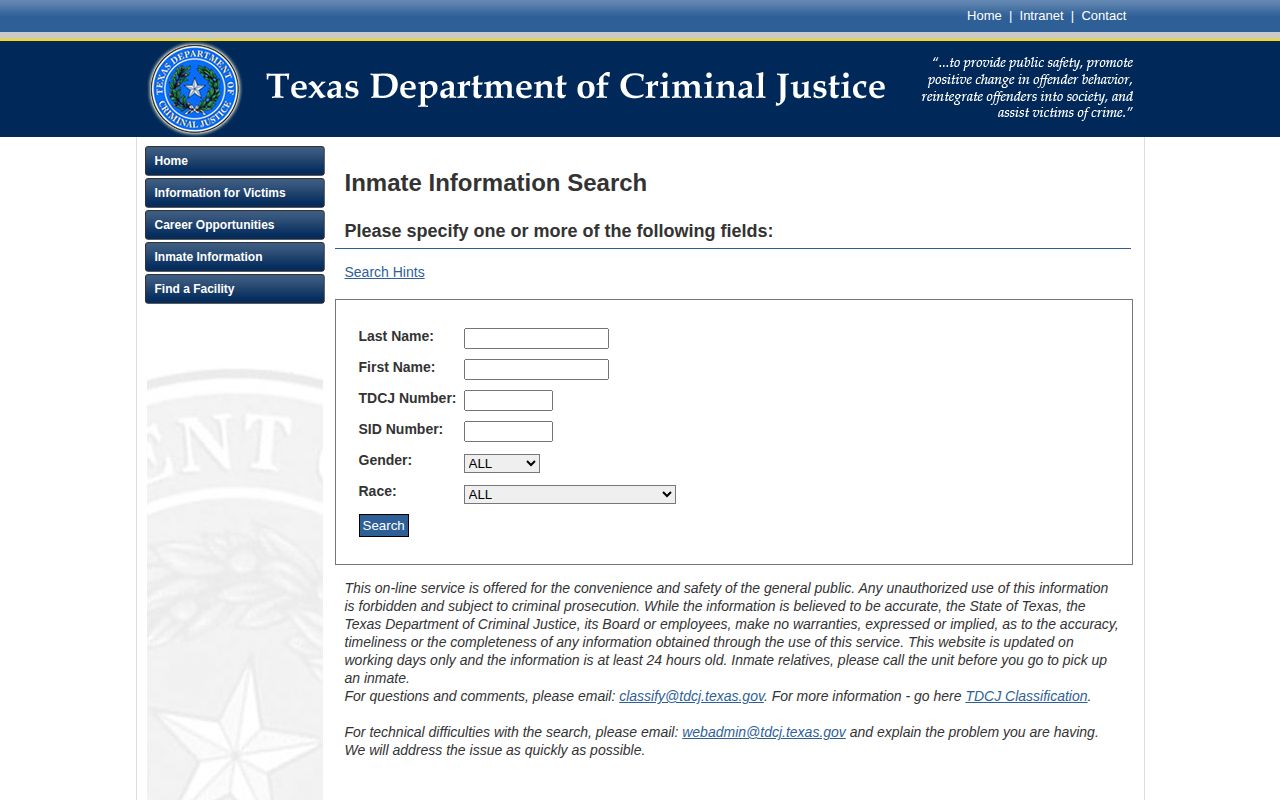
The record should be matched to identifiers and Cass County conviction data before any date or status is attributed to a person.
TDCJ Release Date Meanings
“Projected Release Date” is an official Classification and Records calculation. It reflects the offense and offense date, sentence structure, time credits, mandatory-supervision eligibility, Board action, detainers, and later audits. It is not proof that the person left prison. A maximum sentence date is another calculated endpoint. Parole eligibility is merely the first date the Board may release a person under the controlling rules.
| TDCJ field or event | Meaning |
|---|---|
| Projected release date | Calculated expected departure if parole does not occur sooner, subject to change. |
| Parole eligibility | First possible consideration point, not a promise of release. |
| Scheduled release | Operational date that may appear after approval, audit, and certificate work. |
| Parole | Conditional community release with TDCJ Parole Division supervision. |
| Mandatory supervision | A statutory supervised-release mechanism with eligibility and Board rules. |
| Discharge | Completion of the state sentence. |
A favorable Board vote still requires release processing. The scheduled date can change without notice, even on the date shown. The actual TDCJ release or discharge history remains the retrospective proof.
TDCJ Good Time for Cass Cases
Government Code chapter 498 governs TDCJ good-conduct time. It can affect classification and specified release calculations, but it is not a simple sentence cut or a guaranteed physical release date. Mandatory-supervision rules depend in part on the offense date and eligibility. Modern eligible cases require Board approval for discretionary mandatory supervision.
Texas also has no universal rule that each state prisoner serves 85 percent. Government Code chapter 508 contains offense- and sentence-specific parole rules and mandatory-supervision exclusions. Some cases use actual calendar time equal to one-half the sentence or 30 years, whichever is less, before parole eligibility. Good time does not reach that threshold. Eligibility still does not compel release.
Cass County jail commutation under Code of Criminal Procedure article 42.032 is a separate county system. It must not be used to reverse-engineer a TDCJ projected date, and TDCJ's calculation must not be applied to a county-jail sentence.
TDCJ Release Logistics
TDCJ's public materials say state releases ordinarily occur between 8:00 a.m. and 5:00 p.m. Monday through Friday except holidays, with the unit asked to confirm arrangements. That schedule applies only to TDCJ. Cass County publishes no equivalent county-jail release-hour policy. The state also says some men with detainers, specified classifications, intensive supervision conditions, or electronic monitoring release through the Huntsville Unit.
State materials describe civilian clothing, return of remaining trust-fund money, and a bus voucher when needed. They also distinguish gate-money treatment by release type. Parole or mandatory-supervision release, flat discharge, and state-jail release do not all receive the same treatment. These state processes do not establish what the Cass County Jail provides at a local book-out.
TDCJ's Reentry and Integration Division describes help with replacement identity documents for eligible people before release. Documents held by the program are returned at release under the state process. Family members should confirm the unit, time, and release location rather than assuming a Cass County destination.
A release location may differ from the unit where the sentence was served. The detail screen can add a scheduled release location after records staff complete the needed work. Some classifications and monitoring plans use a designated release site. A person may also report to the Texarkana District Parole Office after release because Cass County is assigned there. The office assignment concerns supervision and does not mean the person was imprisoned in Texarkana or released from a Cass County facility.
Detainers After TDCJ Release
A scheduled TDCJ departure may become an agency transfer when another valid hold exists. A county warrant can route the person to another jail. A federal writ can place the person under U.S. Marshals authority. An immigration detainer can lead to ICE custody. In each case, departure from TDCJ is not the same as release to the community.
If ICE becomes the receiving agency, follow the ICE detainee locator and the relevant immigration custody route. ICE reports that its locator can include people released from ICE custody within a recent period, but an empty result is not proof of community release. The sound record chain is TDCJ departure, receiving-agency intake, and the legal order or hold.
Note: Always name the system in the conclusion, such as released on TDCJ parole, discharged from TDCJ, or transferred from TDCJ to ICE.