
Cass County Release Date Labels
A projected release date is prospective. The TDCJ definitions describe “Projected Release Date” as the date calculated by the Classification and Records Office on which an inmate is expected to leave incarceration if parole does not occur sooner. It can change as the state applies sentence rules, time credits, Board action, and holds. A scheduled release date is a later operational field that may appear after a favorable release decision, audit, and certificate work. It can also change.
The actual release date is retrospective. It records when custody ended. For the Cass County Jail, the sheriff's book-out entry supplies the county timestamp, release authority, and any receiving agency. For TDCJ, the state incarceration history documents release or discharge. A county transfer to TDCJ closes the local booking but does not mean the person went home.
A pretrial detainee usually has no sentence-based release date. Bond, dismissal, a court order, disposition, or a transfer may end the jail stay. Even a posted bond does not show the exact book-out time. The court record explains the legal event, and the sheriff's record confirms the physical departure.
Find Cass County Projected Dates
Begin with the agency holding the sentence. TDCJ searches statewide, so a Cass County conviction may appear at any state unit. No TDCJ unit is listed in Cass County. Searching only nearby prisons can miss the person. For a county-jail sentence, use the Cass County Sheriff and the sentencing court because the TDCJ formula does not control the county calculation.
- Decide whether the person is pretrial, serving a Cass County jail sentence, transferred to TDCJ, or held by another jurisdiction.
- For TDCJ custody, open the official inmate search and use a TDCJ or SID number when available. Otherwise search by name and the offered demographic fields.
- Match the identifiers and county of conviction. Read each date with its exact label, including projected release, maximum sentence, parole review, or scheduled release.
- If the live state result is absent or incomplete, use TDCJ's email or telephone inmate-information channel for the needed history.
- For a Cass County jail sentence, ask the sheriff for the sentence calculation and book-out fields, then compare them with the court judgment and jail-credit language.
The broader Cass County released inmate search can help route a case when the receiving agency is unclear. A roster disappearance alone cannot show which release date applies.
Note: Use two identifiers for a common name, since a same-name TDCJ result may belong to a different county conviction.
TDCJ Projected Release Calculations
TDCJ's calculation draws on the offense title and date, sentence structure, flat time, good-conduct time, mandatory-supervision eligibility, Board action, detainers, and later records audits. Texas Government Code chapter 498 governs TDCJ good-conduct time. It should not be read as a promise that credit always moves the date in the same way. Offense rules and the type of release matter.
For a mandatory-supervision-eligible offense committed before September 1, 1996, TDCJ explains that flat time plus good time reaching the sentence term can produce mandatory-supervision release if parole has not occurred. For an eligible offense committed on or after that date, mandatory supervision is discretionary and requires Board approval. A denial can move the projected date toward maximum expiration or discharge. Later approval can move it earlier. A noneligible case generally uses flat time to maximum expiration unless parole occurs.
- Flat time
- Calendar time actually served in custody.
- Good-conduct time
- TDCJ credit governed by state law and agency classification rules.
- Mandatory supervision
- A supervised release mechanism whose rules depend in part on the offense date and eligibility.
- Maximum expiration
- The sentence endpoint calculated without treating a prior projected date as an actual release.
- Discharge
- Completion of the sentence, distinct from release to supervision.
The TDCJ inmate-information instructions list projected release date among the fields available through the email channel.
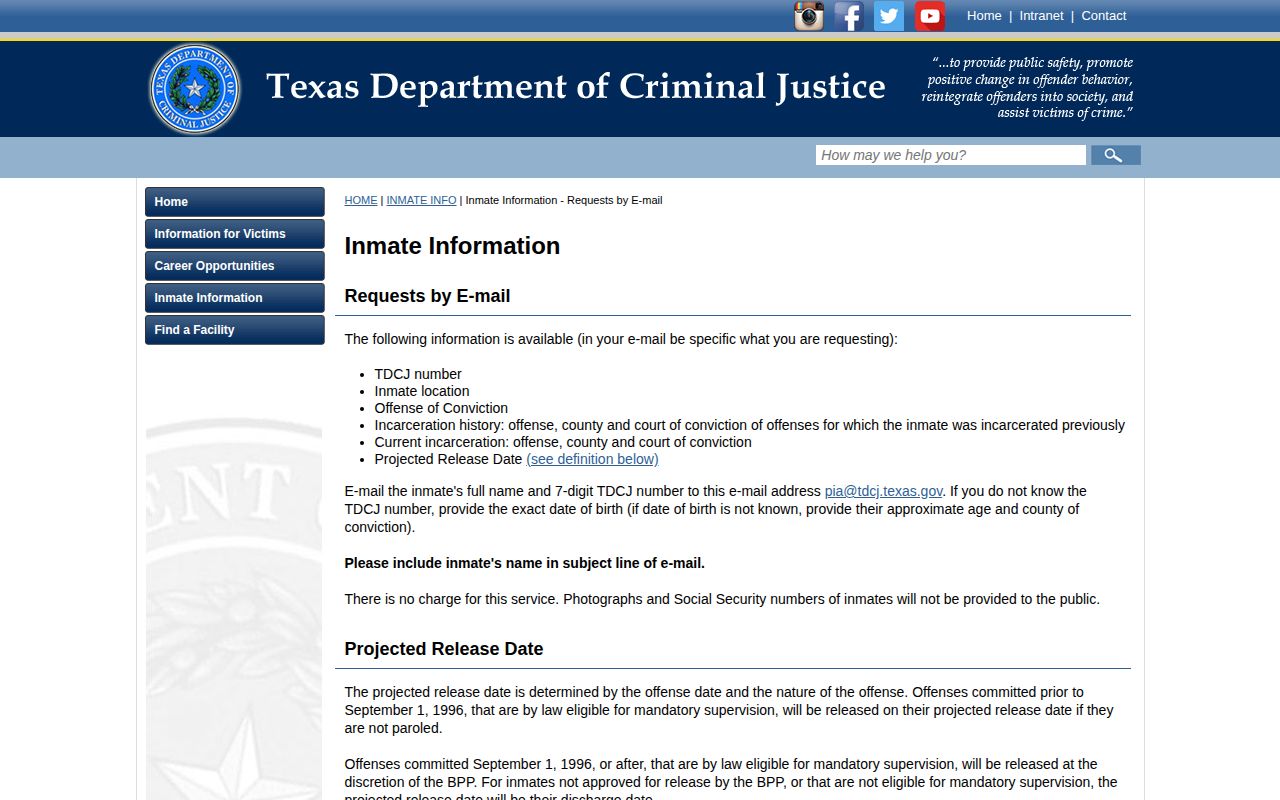
The state information page is also the fallback when a live result does not expose the history needed to connect a Cass County conviction to TDCJ custody.
Why Cass Release Dates Change
A date can move because the facts or legal rules applied to the record change. Sometimes the date stays the same while the meaning changes, such as when a scheduled community release becomes a transfer on another hold. The strongest reading preserves both the date label and the agency that produced it.
| Factor | Possible effect |
|---|---|
| Time-credit audit | Corrected flat-time or good-time data can move a TDCJ projected date. |
| Discipline or good-time loss | Loss or restoration of applicable credit can alter a calculation. |
| Board approval or denial | A parole or discretionary mandatory-supervision decision can change the expected path. |
| Release processing | Audit and certificate work can add a scheduled date and location after approval. |
| Court order or sentence correction | A changed judgment, credit entry, or sentence structure can require recalculation. |
| Detainer or other hold | The person may transfer to another agency instead of entering the community. |
| Concurrent or consecutive terms | The relationship between sentences can change the controlling endpoint. |
A parole eligibility date is only the first date on which the Board may release a person. It is not a promised release date. A favorable Board vote also does not execute the release. The TDCJ Review and Release Processing FAQ describes the remaining work, after which records may show a scheduled date and location.
After a favorable parole decision, records staff still audit the sentence and prepare the release certificate. TDCJ's review-and-release guidance describes a common processing period of about 14 to 21 business days after the certificate is received, but that range is not an appointment or guarantee. A detail screen may later add “Scheduled Release date” and “Scheduled Release location.” TDCJ warns that the scheduled date can change without notice, including on the date shown.
Mandatory-supervision decisions can change the calculation in another way. For an eligible modern offense, Board denial can cause TDCJ to recalculate the projected date toward maximum expiration or discharge. A later approval may move it earlier. For a noneligible offense, maximum expiration generally controls unless parole intervenes. These outcomes depend on the offense, offense date, sentence, and statutory eligibility, so a date from another case cannot be used as a formula.
Detainers must be read as custody events, not merely as reasons for delay. A person may depart a TDCJ unit on the listed day but enter another county jail, federal custody, or immigration custody at once. In that case, the TDCJ departure record and receiving-agency intake can both be accurate. Neither record alone supports the broader claim that the person entered the community.
A later audit can also correct identifiers, sentence relationships, or jail-credit data. Concurrent sentences run together under their controlling terms, while consecutive sentences run in sequence. The court judgment supplies the legal structure, and TDCJ Classification and Records applies it to the state calculation. When a displayed date changes, obtain the labeled record rather than attempting to reverse-engineer the agency's result.
Confirm Cass County Actual Release
For a county case, call the Cass County Sheriff at 903-756-7511 and ask three separate questions: Is the booking closed? What book-out time and release authority are recorded? Did another agency take custody? If current-status staff cannot provide the historical fields, submit a written request to the sheriff for the book-out or jail-register entry. The sentencing court record should then be checked for the judgment, jail credit, bond order, dismissal, or other authority.
For TDCJ custody, compare the inmate detail with the state inmate-information channels. A live detail may show projected release, maximum sentence, parole-review data, and later a scheduled date or location. If actual history is needed after release, request that history rather than treating a vanished search result as proof. TDCJ says its routine email information route is available without charge when the required identifiers are supplied.
A pending county or state event can also be followed through the current Cass County VINELink check. IVSS-Counties covers participating county events, while TDCJ IVSS covers state prison and parole events. An alert should still be confirmed with the custodian.
Note: The release record proves what occurred; the projected and scheduled fields describe what officials expected before that event.
Two Texas Good-Time Systems
Cass County jail credit and TDCJ good-conduct time are not the same system. Code of Criminal Procedure article 42.032 permits a county sheriff to grant commutation for good conduct, industry, and obedience, up to one day deducted for each day of the original sentence actually served, subject to misconduct and the statute's terms. Whether it was awarded in one Cass County case must come from the jail calculation or release record.
TDCJ good-conduct time is governed separately by Government Code chapter 498 and operates inside the state corrections framework. A county sentence cannot be reverse-engineered with TDCJ's online projected date rules. Court-awarded jail credit, sentence structure, holds, and other case facts may also affect the county result. The research found no Cass County fixed daily release time or county-specific weekend-release policy, so no such promise should be added to a calculation.
Cass County Parole Date Myths
Texas Government Code chapter 508 controls parole and mandatory supervision. Section 508.145 contains offense- and sentence-specific parole eligibility calculations, while section 508.149 lists categories excluded from mandatory supervision. The common claim that every Texas prisoner must serve 85 percent is wrong.
For offenses subject to the half-time or 30-year parole rule, the Texas formulation uses actual calendar time equal to one-half of the sentence or 30 years, whichever is less. Good-conduct time does not reach that threshold. That is a parole eligibility rule, not an actual release guarantee. The Board may deny release, and other special rules or exclusions may apply.
Parole, mandatory supervision, and discharge must also remain distinct. Parole is conditional release before sentence expiration. Mandatory supervision is a statutory supervised-release path. Discharge is sentence completion. Each may place a different date on the TDCJ record, and none should be relabeled simply as the day a person “gets out.”
TDCJ Fields for Cass Cases
The official TDCJ search commonly accepts last name, first name, TDCJ number, SID number, gender, and race. A detail result may show identifiers, age, projected release date, maximum sentence date, current facility, county of conviction, offense, sentence date, sentence length, and parole-review information. County of conviction is especially useful because the state may place a Cass County-sentenced person anywhere in its system.
The TDCJ Online Inmate Search shows the search route used for a state sentence.
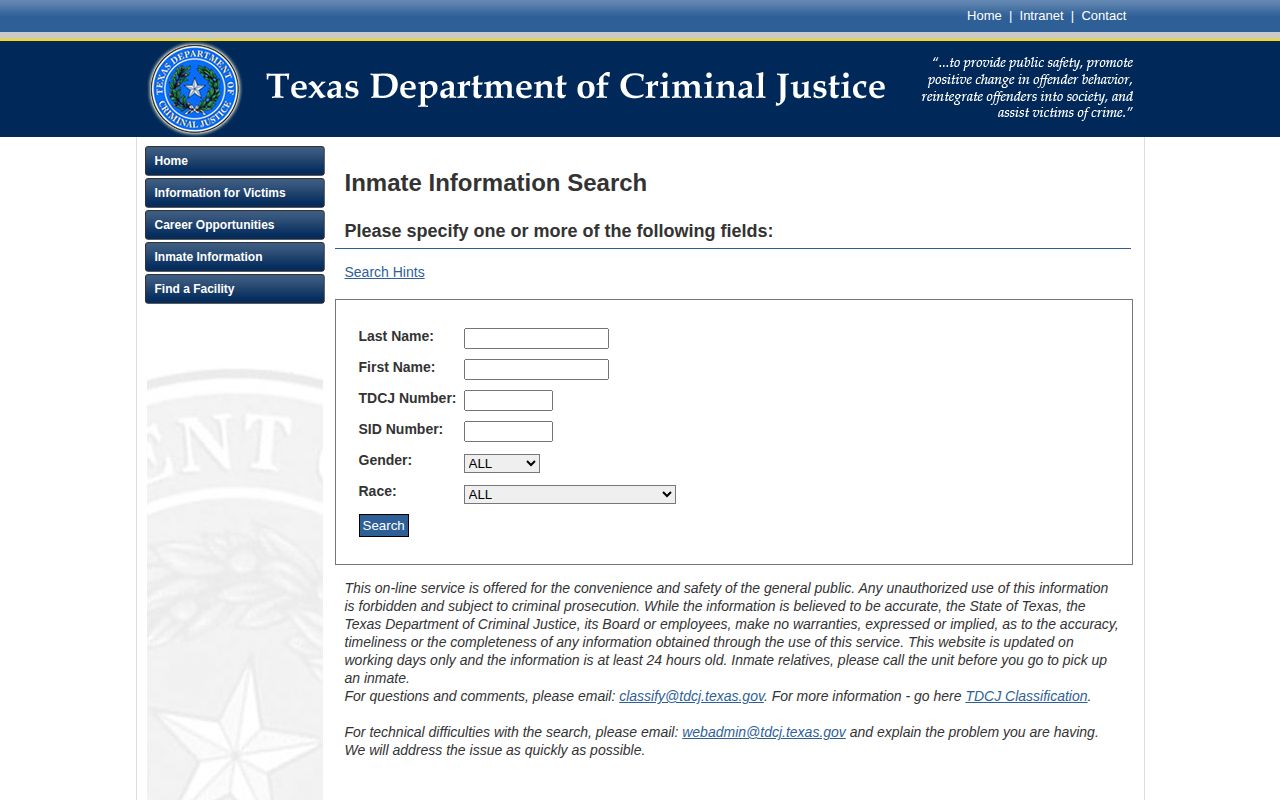
The result must be tied back to the correct identifiers and Cass County conviction before any date is reported as belonging to that person.